The Audubon’s Crested Caracara: Florida’s Bold and Unusual Grassland Raptor
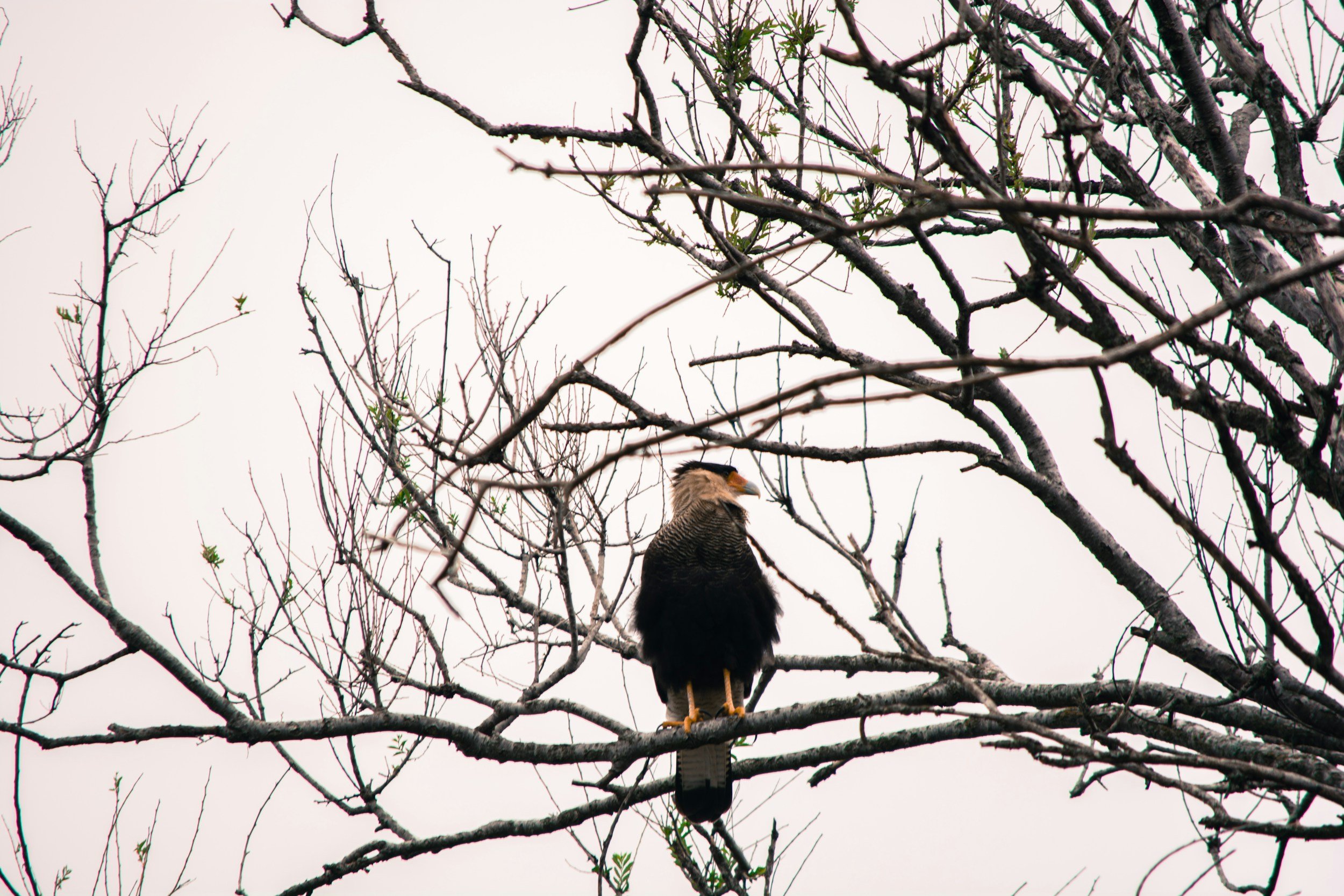
Audubon’s crested caracara (Caracara plancus audubonii)
Posted on February 3, 2026
When you think of Florida wildlife, what comes to mind? Maybe an American alligator sunning itself in the Everglades. Or perhaps a Florida panther quietly stalking through a cypress strand. Or a Florida black bear wandering through a pine flatwood in search of food.
If you had to envision what Florida wildlife looks like, the Audubon’s crested caracara (Caracara plancus audubonii) may not be the first animal that comes to mind. For those familiar with the open prairies and working ranchlands of south-central Florida, this striking bird of prey is more than just a curiosity. It is a living indicator of intact grassland ecosystems and a key consideration in land-use planning, mitigation banking, and conservation banking.
What Is the Audubon’s Crested Caracara?
The crested caracara is a large raptor in the falcon family, though its behavior sets it apart from the high-speed hunters most people associate with vultures, scavenging for carrion and other food sources. They are opportunistic and adaptable foragers. that consume a wide range of food from roadkill, insects, small mammals, and reptiles. They are just as likely to be seen walking on the ground as soaring overhead. Visually, they are unmistakable: bold black-and-white plumage, orange-red facial skin, and a distinctive dark crest. Ecologically, they are just as distinctive, relying on expansive, open landscapes where visibility and access to prey are high.
While crested caracaras can nest in several settings, in Florida, they are closely associated with open prairies and pasturelands dotted with cabbage palms (Sabal palmetto). A single palm rising above a flat grassland can become a critical nesting structure offering elevation, visibility, and protection for adults and chicks.
Because of this relationship, the presence, distribution, and condition of cabbage palms are key indicators biologists evaluate when determining whether land may support nesting caracaras. These same features, open grassland structure, scattered palms, and minimal canopy closure, are also defining characteristics of high-functioning dry prairie and ranchland systems.
Why Crested Caracaras Matter in Florida Land Development
Although crested caracaras are not globally endangered, Florida’s population, known as The Audubon’s crested caracara, is listed as threatened under both federal and Florida law. This designation has been in place since 1987 and carries meaningful permitting and compliance considerations for landowners and developers.
These threats include:
Habitat loss and fragmentation — Conversion of prairies and ranchlands to urban or intensive agricultural uses reduces suitable nesting and foraging habitat.
Vehicle collisions — Caracaras frequently forage along roadways, making them vulnerable to traffic mortality.
Human persecution — Misunderstandings about their scavenging behavior have historically led to illegal harm.
From a regulatory standpoint, the presence, or even potential presence, of crested caracaras can influence project design, construction timing, and mitigation requirements.
Why Crested Caracara Surveys Are Critical
At Revive Ecosystems, wildlife surveys are never treated as a box-checking exercise. Crested caracara surveys, in particular, play a critical role in responsible land development and conservation planning.
Here is why the surveys matter:
1. Informing Development and Land Use Decisions
Surveys identify whether caracaras or active nests occur on or near a project site. Early detection allows landowners and project teams to adjust layouts, buffers, or timelines reducing regulatory risk under the Endangered Species Act and avoiding costly delays.
2. Tracking Population Health and Trends
Crested caracaras are closely tied to the same landscapes that often underpin successful mitigation banks: large, contiguous prairies and ranchlands with limited fragmentation. Survey data helps determine whether a property’s ecological value aligns with preservation-based mitigation, habitat conservation, or species-driven mitigation objectives.
3. Guiding Habitat Conservation
Understanding where and how crested caracaras use the landscape informs decisions about palm retention, grazing regimes, prescribed fire, and long-term land management. These factors directly influence mitigation bank performance.
4. Documenting Functional Ecological Value
Crested caracaras are not just a protected species; they are indicators of functional grassland systems. Their presence strengthens the ecological narrative of a site, supporting both regulatory review and conservation outcomes.
4. Documenting Functional Ecological Value
Crested caracaras are not just a protected species. They are indicators of functional grassland systems. Their presence strengthens the ecological narrative of a site, supporting both regulatory review and conservation outcomes.
5. Reducing Human-Wildlife Conflict
Survey results can inform community outreach and education about caracara behavior and ecology, helping reduce harm.
How Revive Ecosystems Supports Wildlife Surveys & Mitigation Strategy
Florida’s crested caracaras represent more than a single species. They reflect the health, scale, and continuity of the state’s remaining prairie landscapes that are increasingly scarce and valuable from an ecological perspective.
At Revive Ecosystems, LLC, we specialize in bridging science and strategy. Our team conducts rigorous, defensible wildlife surveys such as crested caracara surveys to help landowners, developers, and investors understand both the ecological and regulatory dimensions of their land. Whether supporting mitigation bank planning, due diligence, or long-term land stewardship, we pair field-verified data with practical insight.
Because in Florida, protecting species like the Audubon’s crested caracara isn’t just about compliance. It is about creating enduring ecological value.
Contact us at Revive Ecosystems, LLC to learn how science-based surveys and our mitigation expertise can help your land work harder for both conservation and project certainty.