Longleaf Pine: A Native Framework for Florida Uplands
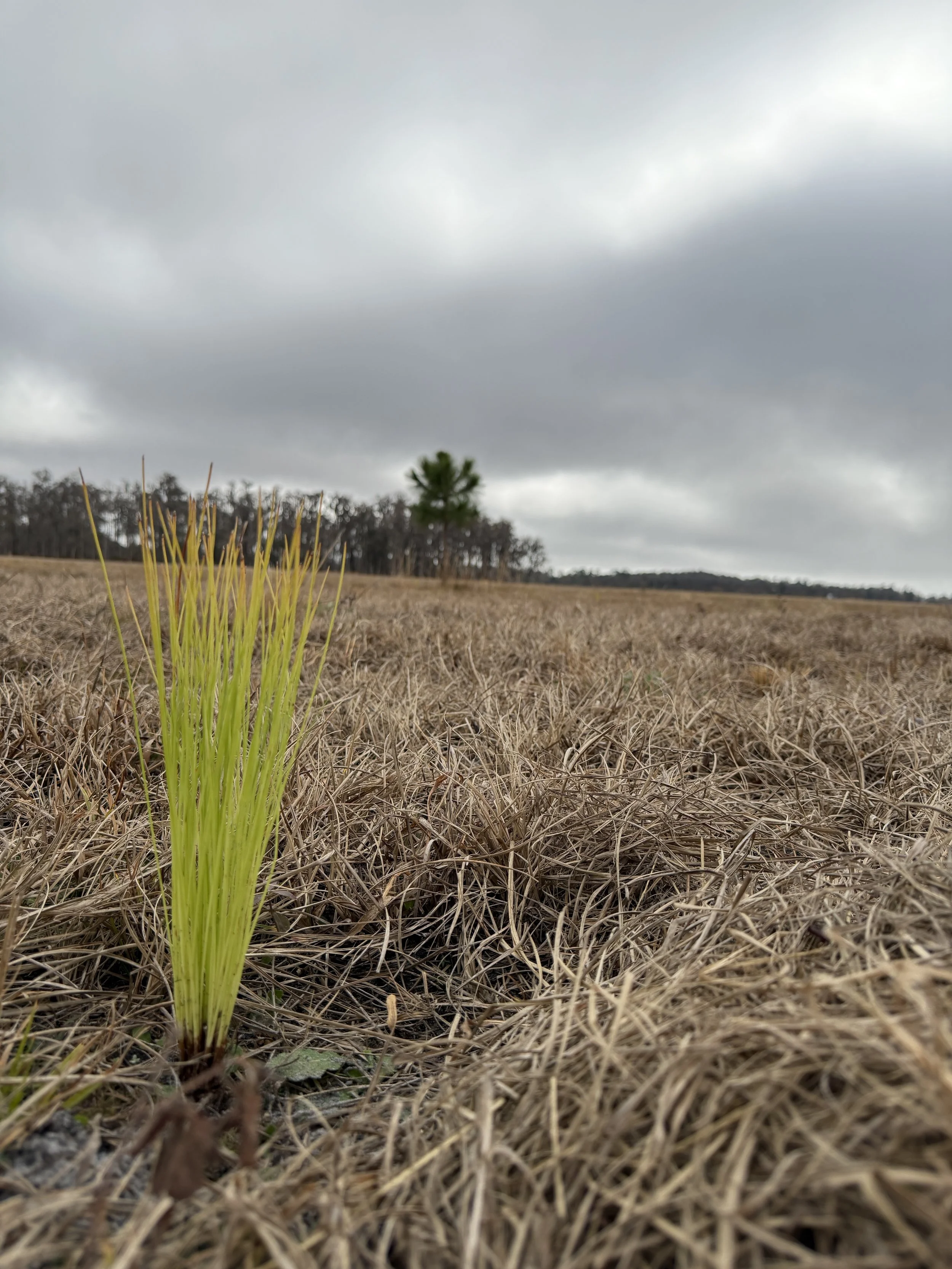
Revive Ecosystems recently coordinated the planting of longleaf pines in Central Florida, reestablishing a native system. This early stage focuses on root development before vertical growth begins which is a foundational step in restoring longleaf pine structure across the landscape.
Posted on February 18, 2026
Longleaf pine (Pinus palustris) is a native evergreen tree historically widespread across the southeastern United States, including much of Florida. Within the state, it is most closely associated with upland sandhill and other well-drained pine communities, particularly in the Panhandle, north Florida, and portions of north-central Florida.¹
Today, longleaf pine remains an important component of Florida’s upland landscapes and is the focus of restoration efforts on public and private lands. Understanding why longleaf pine is restored requires examining its ecological characteristics, historical distribution, and role in contemporary land management.
Where Longleaf Pine Occurs in Florida
In Florida, longleaf pine is most commonly found on:
Deep, well-drained sandy soils
Upland ridges and terraces
Sandhill ecosystems
Some well-drained flatwoods
These areas are typically positioned above the seasonal high water table and differ from adjacent wetlands in soil drainage and vegetation structure.¹ ²
Longleaf pine remains present across state forests, national forests, conservation lands, and private properties where soils and hydrologic conditions are suitable.³
Physical Characteristics and Growth Pattern
Longleaf pine can be distinguished from other southern pines by several defining traits:
Long needles (8–18 inches) in bundles of three
Large cones
Thick, fire-resistant bark on mature trees
A relatively open crown in older stands
Under suitable site conditions, mature longleaf pines commonly reach heights of 80 to 125 feet.¹
A notable feature of the species is its early “grass stage.” During this phase, seedlings remain low to the ground while developing a deep root system. After this stage, vertical growth accelerates.¹ ⁴ This growth pattern contributes to the species’ tolerance of periodic surface fire.
Fire and Ecosystem Structure
Longleaf pine ecosystems are closely associated with recurring surface fire. Historically, lightning-ignited fires occurred regularly across Florida’s upland landscapes.²
Fire affects:
Tree density
Midstory shrub development
Groundcover composition
When maintained with periodic fire, longleaf pine systems often develop widely spaced canopy trees and a ground layer dominated by grasses and herbaceous plants.¹ ²
Prescribed fire is widely used on public and private lands in Florida to manage upland pine communities. Fire frequency and timing influence long-term ecosystem structure.² ³
Wildlife Associations
Longleaf pine uplands provide habitat for wildlife species adapted to open, sandy environments. Species documented in Florida longleaf systems include:
Gopher tortoise (Gopherus polyphemus)
Northern bobwhite (Colinus virginianus)
Sherman’s fox squirrel (Sciurus niger shermani)
Wildlife occurrence varies based on habitat structure, fire management, and landscape context.²
Historic Decline and Present Distribution
Longleaf pine experienced a significant decline during the late 19th and early 20th centuries due to extensive timber harvest, land conversion, and changes in fire regimes.³
The present distribution of longleaf pine in Florida reflects soil suitability, land use history, and ongoing management practices.³
Why Longleaf Pine Is Restored
Longleaf pine is restored on appropriate sites for several documented reasons:
Reestablishing native upland plant communities within their historical range³
Restoring characteristic ecosystem structure, including open canopies and herbaceous groundcover¹ ²
Supporting habitat conditions associated with open upland pine systems²
Compatibility with prescribed fire, a common land management tool in Florida² ³
Restoration typically involves planting longleaf pine seedlings, managing competing vegetation, conducting prescribed burns where appropriate, and monitoring vegetation structure over time.³
Longleaf Pine in Contemporary Land Management
Today, longleaf pine restoration occurs across public lands, conservation areas, and private properties including mitigation and conservation banks throughout Florida. The species is planted where soil type, drainage, and long-term management capacity support its establishment and maintenance.³
Longleaf pine ecosystems represent a fire-adapted upland system shaped by soil conditions, vegetation dynamics, and management practices. Restoration efforts reflect broader land management objectives aimed at maintaining native upland landscapes within Florida’s ecological framework.
End Notes
University of Florida IFAS Extension. Longleaf Pine (Pinus palustris). UF/IFAS EDIS Forestry Publications.
Florida Fish and Wildlife Conservation Commission (FWC). Longleaf Pine Ecosystems in Florida.
Florida Forest Service (Florida Department of Agriculture and Consumer Services). Longleaf Pine Ecosystem Management and Restoration.
U.S. Department of Agriculture Forest Service. Silvics of North America, Volume 1: Conifers — Longleaf Pine (Pinus palustris).