A Closer Look at Florida’s Black Creek Crayfish: A Small Species Facing Big Challenges
Posted on April 21, 2026
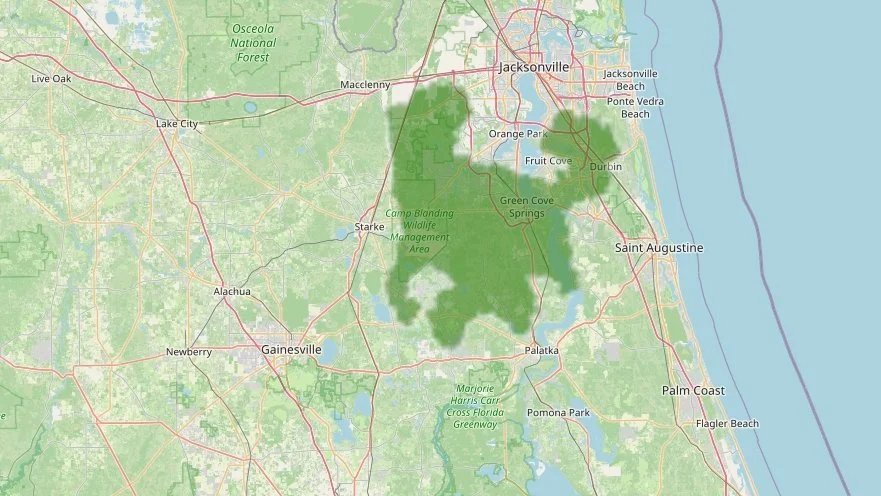
Florida’s freshwater systems are home to a remarkable diversity of species, many of which go unnoticed. One such species is the Black Creek crayfish (Procambarus pictus), a small but ecologically important crustacean native to the Lower St. Johns River Basin in northeastern Florida.
Although currently designated as State-Threatened in Florida, the Black Creek crayfish is not yet federally listed. However, in 2024, the U.S. Fish and Wildlife Service (USFWS) proposed listing this species as federally endangered, along with the designation of over 650 miles of critical habitat, highlighting growing concern for its long-term viability.
The Black Creek crayfish is a mid-sized crustacean, reaching up to about three inches in length. But despite its modest size, this crayfish plays an important ecological role as a detritivore, feeding on decomposing plant and animal material and helping to cycle nutrients through aquatic systems. These crayfish have a relatively short lifespan, approximately 16 months, and reproduce only once.
Black Creek crayfish are highly specialized in their habitat requirements. They inhabit:
Tannin-stained, sand-bottomed streams
Cool, well-oxygenated, flowing water bodies
Areas with aquatic vegetation and woody debris for shelter
Systems with a mix of shaded and open canopy
Their distribution is limited to just four counties: Clay, Duval, Putnam, and St. Johns, making them particularly vulnerable to localized disturbances.
Because they rely on high-quality headwater systems, Black Creek crayfish are especially sensitive to environmental changes, including water quality degradation from pollution and sedimentation, habitat alteration from urbanization, road erosion, and silviculture, and hydrologic changes, including damming and temperature shifts
However, another, more recent threat is emerging — the white tubercled crayfish (Procambarus spiculifer).
The white tubercled crayfish is a larger, more competitive species that has dramatically altered the landscape for Black Creek crayfish. Since its first detection in the basin in 2008, this invasive competitor has expanded rapidly. Recent surveys indicate that white tubercled crayfish now occupy 68% of sites historically occupied by the Black Creek crayfish, yet only 48% of these historical sites are still occupied by the endemic Black Creek crayfish.
Competition for shelter and resources, in addition to differences in growth rate and reproductive strategy, is driving displacement and potentially widespread local extirpation of the small but mighty Black Creek crayfish.
So why should we care about this small crustacean? Because the Black Creek crayfish is more than just a single species at risk. It is an indicator of overall stream health in this region, and its decline reflects broader environmental pressures affecting freshwater ecosystems across Florida.
The proposed federal listing underscores a critical shift. While the species was previously considered not warranted for protection in 2021, new data, particularly regarding invasive species pressure, has significantly changed its outlook.
Looking ahead, the protection of the Black Creek crayfish will require a combination of habitat conservation and restoration, water quality protection, and management of invasive species pathways, including public awareness around bait release and aquarium dumping.
As environmental professionals, staying informed on species like the Black Creek crayfish helps guide better decision-making in land use, restoration planning, and regulatory processes.
Small species often tell the biggest stories, and in this case, the story is one of rapid change, increasing pressure, and the urgent need for proactive conservation.
Protecting species like the Black Creek crayfish starts with informed action.
Connect with Revive Ecosystems, LLC to learn how we restore and enhance freshwater habitats and help reduce the pressures facing these systems.